

Search “how to market your business” and almost everything you find assumes one thing: that buyers can try before they buy.
Sign up for the free trial. Watch the two-minute demo. Cancel anytime. That entire playbook is built for software and services, where the product is one click away and the risk of trying it is close to zero.
Physical products don’t work that way. You can’t email someone a precision instrument to test over the weekend. The purchase is expensive, physical, and hard to reverse. And the people deciding usually aren’t the people who understand the engineering.
So the standard advice doesn’t just fall short. It sends you in the wrong direction.
Most Marketing Advice Wasn’t Written for You
The marketing world runs on software examples. Funnels, free trials, product-led growth, viral loops. All of it assumes a low-cost, low-risk, self-serve buy.
Your buyer is making a different kind of decision. They’re spending real money on something that ships on a pallet, sits on a factory floor, and has to work for years. They can’t undo that with a cancel button. So they move carefully, they involve other people, and they want proof before they commit.
None of the usual tactics account for that. Which is why physical products companies keep hearing advice that sounds smart and produces nothing.
What Actually Makes Physical Products Different
Four things separate marketing a physical product from marketing almost anything else.
- The buying cycle is long and crowded.
A software buyer can decide alone in an afternoon. A physical products buyer is running a process. Procurement, engineering, operations, and finance all weigh in. Each one cares about something different, and your messaging has to speak to all of them without turning into noise.
- The value is invisible on a datasheet.
What makes your product better often can’t be seen in the moment of purchase. Reliability, uptime, lower total cost over five years, fewer failures on the line. These are outcomes that show up later. Buyers have to believe them before they experience them.
- The legacy communication is built on specs.
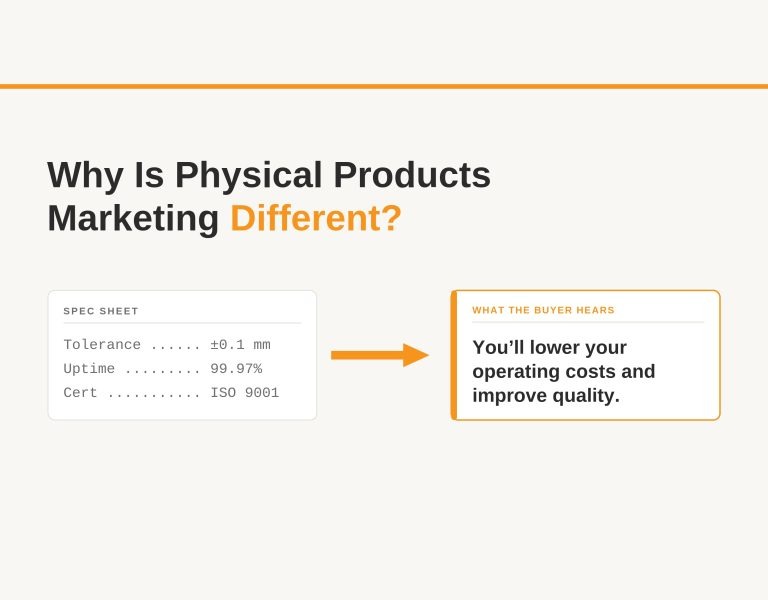
Physical products companies are usually run and staffed by technical people. The website, the sales deck, and the spec sheet were written by people who think in tolerances and materials. That’s precise. It’s also aimed at an audience that already understands why the numbers matter. Buyers don’t.
- Trust carries more weight because the stakes are higher.
Nobody loses their job over a canceled software subscription. People do get blamed for a six-figure capital purchase that underperforms. That raises the bar. Proof, references, and credibility matter more here than in almost any other category.
Two People Feel This Gap
In physical products companies, the same problem shows up on two very different desks.
The first is the founder. Call him Alan.
Alan is an engineer or an inventor. He built the product, and he’s proud of it, with good reason. When he talks about it, he leads with what it does: the precision, the materials, the performance. That’s how he thinks and how his whole team communicates. The trouble is that buyers aren’t engineers. They compare spec sheets, don’t see the difference, and go with the cheaper option. Alan knows he’s leaving deals on the table. He just can’t see why a clearly better product keeps losing.A meaningful share of that conviction-building now happens through AI tools, before a buyer ever talks to your sales team. How Physical Products Companies Show Up in AI Search is the deeper dive on what those buyers are asking and how to show up in the answer.
The second is the CEO who was hired to grow the company. Call him Dan.
Dan didn’t build the product. He was brought in by the board to scale it. When he looks at the marketing, he sees the problem immediately: it was written by founders who sold on relationships and deep product knowledge, one call at a time.
 That worked when a founder was in every meeting, translating specs into value on the fly. It doesn’t work now. Dan can’t be on every call, and his sales team can’t be the founders. The messaging has to carry weight it was never built to carry.
Different seats, same gap. Alan is too close to the product to see it. Dan inherited it and can’t unsee it. Both are stuck at the same place: a great product described in a language buyers don’t speak.
Why Generic Marketing Advice Fails Here
This is where most outside help goes wrong.
Agencies show up wanting to run campaigns before they understand the product. They talk in metrics and tactics that feel disconnected from the actual business. They’ve never had to translate a tolerance stack into a reason to buy, so they don’t. They just make the spec sheet louder.
Design-first rebrands miss it too. A cleaner website doesn’t fix the words on it. If the page still leads with specs, a nicer layout just makes the wrong message look better.
And leaning on founder relationships isn’t a strategy. It’s a ceiling. It works until the founder runs out of hours, and then growth stops.
The real problem sits underneath all of these. The company is speaking in specs to buyers who are asking about outcomes. That gap has a name. We call it the specs-to-connects problem. And it’s fixable.
What to Do Instead
You don’t fix this by dumbing down the product. You fix it by translating what the product does into what it means for the buyer. Two simple tools do most of the work.
The So What? Drill.
Take any spec and ask “so what?” until you reach something the buyer actually cares about. Watch it move in three steps:
“Our system holds tighter tolerances.” So what?
“So parts fit right the first time.” So what?
“So the line stops less, and you ship more without adding people.”
That last line is your marketing message. The first line is a spec sheet. Same fact, translated into an outcome the buyer can picture.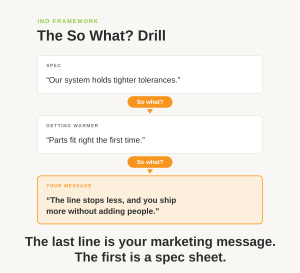
The Before/After Map.
Describe the buyer’s world the day before they buy, and the same world ninety days after. The day before: constant rework, unplanned downtime, a team stretched thin. Ninety days after: fewer failures, predictable output, breathing room. The gap between those two pictures is your message. Not the spec that closes the gap, the change the buyer feels.
Neither tool requires a rebrand or a bigger budget. They just point your existing message at the person actually making the decision.
The Bottom Line
Physical products marketing is different because the buy is bigger, slower, and riskier, and because the value lives in outcomes a spec sheet can’t show. The companies that win aren’t the ones with the best specs. They’re the ones that translate those specs into something the buyer understands and wants.
So here’s the question worth sitting with: if a buyer landed on your homepage today, would they see what your product does, or would they see what changes for them after they buy it?
If you’re not sure, that’s the gap. And it’s worth finding before it costs you another deal.
See where your messaging stands Take the Product Messaging Score. Seven questions, about three minutes, and you’ll get a clear read on how big your specs-to-connects gap is and where to start closing it. Take the Product Messaging Score Prefer to talk it through? Book a complimentary call. |
FAQ
Is B2B physical products marketing really different from B2B software marketing?
Yes. Software marketing leans on free trials, self-serve signups, and fast, low-risk decisions. Physical products are expensive, hard to reverse, and bought by a group. The value often shows up over years, not in a demo, so the messaging has to build belief before the buyer ever experiences the result.
Why do technical founders struggle with marketing?
Engineering training rewards leading with data and covering every specification. That’s exactly right for an audience of engineers. Buyers aren’t that audience. They’re asking what changes for them after they buy, and a spec sheet doesn’t answer that question.
What is the specs-to-connects gap?
It’s the distance between how a technical company describes its product and how its buyers actually decide. The company speaks in specs. The buyer is asking about outcomes. Closing that gap, moving from specs to connects, is what turns a strong product into a message that sells.
How do I start fixing my product messaging?
Pick one spec you lead with and run it through the So What? Drill until you reach a buyer outcome. Then map the buyer’s world before and after the purchase. Start with your homepage headline and your top product page, since those carry the most weight.