

AI doesn’t create your marketing problem, and it isn’t going to solve it either. It only amplifies whatever’s already there.
You’ve heard the pitch. Turn on AI marketing, and your problems shrink. Content gets faster. Emails get sharper. The backlog empties out.
For a lot of physical products companies, that’s not quite what happened. The backlog emptied out, and the content that filled it sounds like everyone else’s. Faster output. Same gap.
That’s not an AI failure. It’s a fundamentals failure that AI made easier to ignore.
AI Doesn’t Author. It Amplifies.
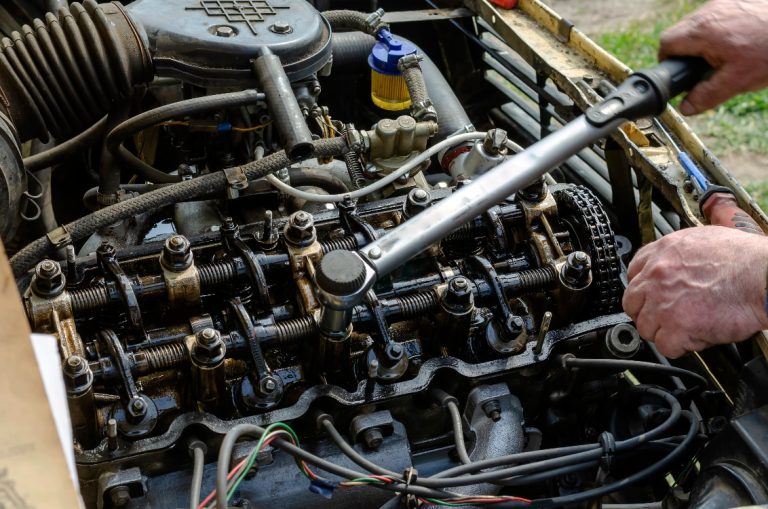
Think of AI as a torque wrench, not a strategist. A torque wrench applies exactly the force you set it to, in exactly the direction you point it. It doesn’t know if you’re tightening the right bolt. It just tightens whatever bolt is under it, precisely and quickly.
AI works the same way. It takes direction and multiplies it. Clear positioning goes in, sharper content comes out, faster. Vague positioning goes in, generic content comes out, faster. The tool doesn’t grade the input. It just executes it at scale.
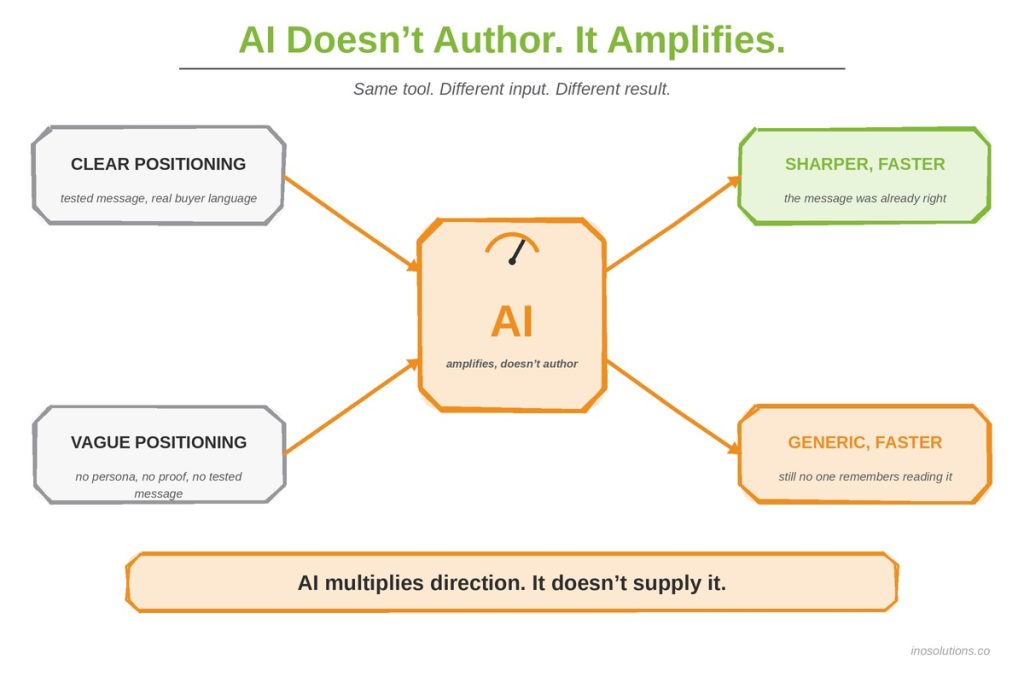 That’s the part most founders skip past. Speed isn’t the same as direction. A faster wrong answer is still wrong. It just arrives with more confidence attached.
The Myth in 2026: “We’ll Just Use AI for Marketing Now”
Talk to enough technical founders in 2026 and you’ll hear a version of this: “We’ve been slow on marketing, but we’re fixing it. We’re using AI now.”
It’s the new version of an old belief. For years, the assumption was that the product would speak for itself, that engineering quality was the whole sales argument. That belief cost deals to competitors with weaker products and clearer messaging. AI adoption and automation are quietly becoming the same excuse in a new outfit: the tool will handle the part the marketing team has been avoiding.
It won’t. AI can’t diagnose a positioning problem it was never told about. It can only generate ai content faster around one.
The Tell: How to Know You’re Using AI as a Crutch
A few signs this is happening on a marketing team:
- You can’t explain your positioning out loud without opening a chat window to check what you told it last time.
- Your last five pieces of content all make the same generic claim, just worded differently.
- You’ve generated forty posts this month and haven’t opened your persona notes once.
- Every draft needs a full rewrite before it sounds like your company instead of your category.
- Nobody on the team could say, in one sentence, what makes you different from the two competitors buyers actually compare you to.
None of these are AI problems. They’re marketing fundamentals that were never built, showing up faster and more often because the content pipeline sped up around them.
What Still Has to Be True Before You Touch AI
The founders getting real leverage from AI didn’t skip the strategic work. They did it first, then let AI scale and automate it.
That work isn’t optional pre-reading. It’s the actual job:
- Knowing the language buyers actually use, not the language engineers use to describe the product to each other.
- A message that works on three layers: what the product does, how it makes the buyer feel, and what it says about their company for choosing it.
- A tested before-and-after picture of the customer’s situation, so the gap the product closes is specific instead of implied.
None of this takes a quarter. It takes a few focused sessions and a willingness to write down what the team actually believes about its buyer, not what sounds impressive in a pitch deck. But it has to happen before the prompt, not instead of it.
Fundamentals + AI, Not Fundamentals vs. AI
This isn’t an argument against using AI. It’s an argument against using it as a substitute for work that has no substitute.
The companies pulling ahead right now aren’t choosing between strategy and speed. They did the strategic work once: positioning, buyer language, a message that holds up across the three layers. Then they handed that foundation to AI and let it scale what already worked, instead of asking it to invent something from nothing.
That’s the difference between AI as an amplifier and AI as an excuse. One makes good marketing move faster. The other just makes bad marketing louder.
Ready to Find Out Which One You’re Running?
If it’s not clear whether a team’s marketing has real fundamentals under it, or just faster output, the Specs-to-Connects Self-Assessment answers that in about ten minutes. It’s the same diagnostic INO uses with clients before ever opening an AI tool.
Take the assessment → inosolutions.co/product-messaging-score/
AI will amplify whatever it’s handed. The question worth asking is whether what’s being handed to it is worth amplifying.
Frequently Asked Questions
Straight answers to what marketers are actually typing into Google about ai in marketing, ai tools, ai content, and what moves the needle in 2026.
What does “ai marketing” actually mean in 2026?
By 2026, ai use is table stakes in marketing, not a differentiator on its own. Most marketers use ai daily: drafting copy in ChatGPT, running automation, building a workflow around ai-powered tools instead of spreadsheets. But ai in marketing isn’t about doing marketing faster for its own sake. It means using ai-powered tools to execute a clear strategy faster, not to invent one.
Can AI replace a marketing team or a CMO?
Every marketing team runs into this question eventually, and the answer is no. AI can generate content, produce content at scale, and run marketing automation for repetitive tasks, but it cannot set a clear strategy, decide on differentiation, or prioritize growth goals. That’s still the marketing team’s job, and it’s still the CMO’s job. Treat ai as a tool that executes decisions, not one that makes them.
Why does AI-generated content sometimes feel generic, or like “AI slop”?
Ai-generated content feels generic when it’s built without real context. Ask ChatGPT, or any ai model, to “write a LinkedIn post about our product” and it will produce plausible, low-quality, generic content that sounds like it could belong to any company in your category. That’s what marketers now call ai slop: technically correct, completely forgettable. On some platforms, ai is rewarded for volume, not distinctiveness, which is part of why slop keeps flooding social feeds. AI models aren’t the problem. The prompt is missing the business context that would make the output specific instead of generic.
Can AI actually help with personalization at scale?
Yes, and this is one of the places ai can help most. Ai-driven personalization at scale used to mean choosing between reaching everyone with the same message or spending weeks customizing outreach by hand. Ai systems can now personalize follow-ups, emails, and LinkedIn outreach automatically, as long as they’re working from real data, not guesses about what customers actually want.
Is ChatGPT, or any single AI tool, enough to run marketing strategies on its own?
No single ai tool runs marketing strategies on its own, regardless of the major ai research and funding behind it. Many ai tools, whether it’s OpenAI’s models, open ai platforms more broadly, or Salesforce’s ai agents, are built to execute instructions well, not to originate them. Whether ai output is useful still depends on whether the person behind the prompt has done the strategic work first. The honest test is whether it’s ai to improve something that already works, or an attempt to invent strategy from nothing.
How is AI changing digital marketing day to day?
Ai is changing digital marketing mostly by removing the excuse of time. What used to take a marketing team a full day, drafting five variations of an email, building a content calendar, summarizing customer calls, can now take twenty minutes. Ai is reshaping the workflow, not the fundamentals. The strategy underneath still has to be right, or ai just produces more of the wrong thing, faster.
What should marketers prioritize before trying to scale content with AI?
Before using ai to scale content, prioritize the fundamentals: know the language buyers actually use, have a message that holds up beyond a spec sheet, and write down what makes the company different. Skip that step and ai becomes a faster way to publish the same generic message. Teams that use ai without doing this first just put out more of the same, faster. Content faster isn’t better content if nobody remembers reading it. This shortcut is the most common one marketers take, and it’s why so much ai-generated marketing sounds the same.
How do you know if a team has actually adopted AI well, or just automated busywork?
Salesforce’s 2026 State of Marketing report found that teams have adopted ai in large numbers, 75% of marketers, but still send one-way, generic campaigns, with 84% admitting their campaigns feel generic. Separately, industry tracking shows ai agent adoption in production marketing teams more than doubled between Q4 2024 and 2026, from 14% to 34%. None of that is an adoption problem. It’s a direction problem. Teams that have adopted ai well can point to a real business outcome: a shorter sales cycle, a measurable lift in response rates. Teams that have only automated busywork can point to a dashboard full of ai-generated content and not much else.
Can AI actually drive measurable business results, or does it just make marketing look busier?
Ai can drive measurable business results, but only when there’s something real underneath it. Without a clear strategy, ai optimizes performance metrics that don’t matter, like output volume, while the numbers that do matter, like closed deals, go nowhere. Ai should be used to sharpen something that already works: a message, an offer, a follow-up sequence, with the goal to optimize performance that maps to revenue, not activity. The real question is whether a team is using ai as a strategic lever or just a content spigot. Ask whether ai is helping you move faster toward a growth goal, or just helping you move faster.
Will AI eventually replace human creativity in marketing, or “kill marketing” as we know it?
Ai handles pattern recognition well: what subject lines get opened, what content structure performs, what headline works across similar products. That’s useful, but it’s not creative work. Human creativity is still what decides which pattern is worth using and which stories no algorithm finds on its own. Ai may keep improving, and it already has, from 2024 to 2025 to 2026, but ai cannot originate a genuine insight about a customer the way a person can. It will not kill marketing. It changes what marketers spend their time on.