

Most physical products companies have a marketing problem hiding in plain sight. Here’s how to fix it.
Physical products companies invest enormously in engineering. Years of iteration, precision manufacturing, rigorous QA. And yet, they routinely lose deals to competitors with inferior products.
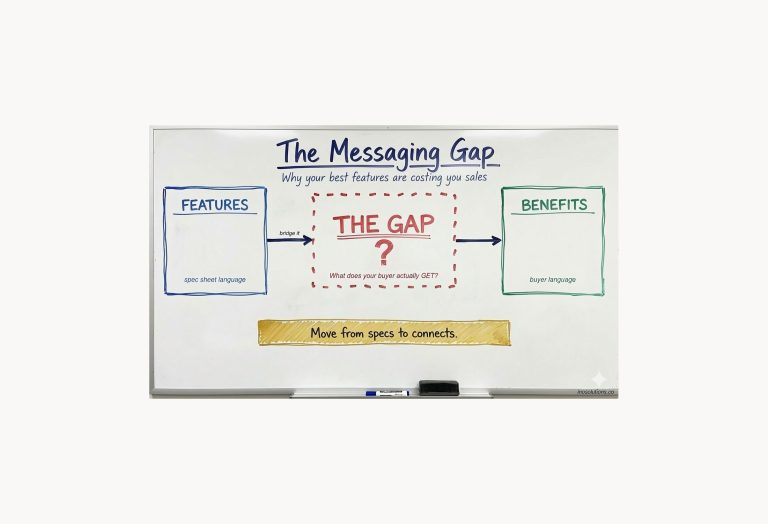
The product isn’t the problem. The gap between what you built and what your buyer hears is.
This isn’t a creative problem or a budget problem. It’s a framing problem, a positioning problem — and once you see it, it’s fixable.
Features Are Not Benefits
Technical founders reach for the language they know best: features. Tolerances, materials, certifications, cycle times, resolution, etc. It’s precise, defensible, and exactly what engineers care about. The problem is that your buyer isn’t evaluating your product the way your engineering team does.
Buyers are asking a different question: “What does my life or business look like after I buy this?”
Features don’t answer that question. Benefits do.
Here’s a quick test: take your current homepage headline and ask whether it could describe a competitor’s product. If the answer is yes — and for most physical products companies, it is — your headline isn’t doing its job.
“Precision-engineered for reliability” tells a buyer nothing about their life after purchasing. What does reliability mean to them specifically? Fewer shutdowns? Less field troubleshooting? Passing an audit they’ve failed twice? Each of those is a different story and a different sale.
Buyers increasingly run this same evaluation through AI before they ever call you, and AI reads a spec sheet the same way an untrained buyer does. Without context, it can’t turn tolerances into outcomes either. How Physical Products Companies Show Up in AI Search covers what buyers are asking AI before they ever reach out.
The “So What?” Drill
The fastest way to bridge the gap from feature to benefit is a simple technique: take your strongest feature and ask “so what?” three times.
Here’s what it looks like in practice:
“Our sensors have 0.1mm precision.”
So what?
“They catch defects in real time.”
So what?
“You eliminate warranty returns.”
That last line is your marketing message. The first is a spec.
Run this drill on your top three features. Push past the first “so what?” — the real message almost always lives at the second or third level. That’s where the buyer’s world comes into focus.
The Before/After Map
Another powerful tool is mapping your customer’s world in two snapshots: the day before they bought your product, and 90 days after.
The gap between those two states is your core marketing message. But the key is specificity. Vague outcomes — “improved efficiency,” “greater reliability,” “peace of mind” — don’t convert. Specific outcomes do.
“Six hours of weekly calibration becomes twenty minutes.”
That sentence converts. It paints a before, implies an after, and makes the value tangible without requiring the buyer to do any interpretive work.
The more specific you can get — in numbers, in time, in friction removed — the more credible and compelling the message becomes.
Where is your messaging gap?
Most physical products companies have one. The question is where. The Product Messaging Score is a 7-question, 3-minute assessment that shows you exactly where your messaging connects with buyers — and where it’s costing you deals. It’s free, so click the button to get started.
Mine Your Customers, Not Your Team
Here’s where most companies make the biggest mistake: they ask their internal team what makes the product great.
Your team knows the product deeply. That depth is also a liability. They’re too close to it. They instinctively reach for technical language because that’s how they think about the product every day.
Your customers don’t think about your product that way. They think about their problem. And the words they use to describe that problem — and the relief they felt when it was solved — are almost always better copy than anything your internal team writes.
Practical ways to gather it:
- Post-purchase interviews: ask buyers why they chose you, in their own words
- Sales call recordings: listen for the language prospects use when describing their pain
- Support tickets: complaints and questions reveal what matters most to people using the product
- Review mining: if you have reviews or testimonials, pull the phrases that recur — those are your headlines
The goal is to use your customer’s words back to them. When a prospect reads your copy and thinks “that’s exactly my problem,” the sale is already more than halfway done.
Build Your Message in Three Layers
The most durable product messaging operates on three levels simultaneously. Most competitors only compete on the first.
Functional: What the product does, expressed as an outcome. “Reduces unplanned downtime by 40%.” This is the baseline. It’s necessary, but it’s not differentiating on its own because competitors can make similar claims.
Emotional: How owning or using the product makes your customer feel. “Confident going into an audit.” “Not the one scrambling at 2am.” Emotional messaging creates connection that specs can’t. Buyers are people first. They want to feel something about the decision they’re making.
Identity: What the product says about the company that uses it. “We don’t miss defects.” “Our line doesn’t go down.” Identity messaging is the most powerful layer because it aligns your product with who your buyer wants to be. It taps into professional pride and organisational values.
When you address all three, your messaging does something competitors’ spec sheets can’t: it makes a buyer feel understood. That’s when you stop being an option and start being the choice.
Consistency Is the Multiplier
A messaging framework only compounds in value when your whole team uses it. The strongest messaging in the world loses its power when it lives only on the website while your sales team tells a different story at trade shows and your campaign team writes a third version for email.
Consistency is how messaging becomes trusted. Repetition isn’t redundancy — it’s reinforcement. Every touchpoint that uses the same language makes the message more credible, not less interesting.
When rolling out a messaging framework across a team:
- Document it in a shared, accessible reference that sales, marketing, and leadership all contribute to and use
- Build approved language for common scenarios — the one-liner, the elevator pitch, the trade show introduction
- Review it when the product changes, when you enter a new market, or when you’re losing deals you should be winning
The framework is the foundation. Consistency is the multiplier.
Ready to Close the Gap?
Building a messaging framework is one of the highest-leverage investments a physical products company can make. It sharpens every channel at once — your website, your sales conversations, your trade show presence, your campaigns.
If it’s on your radar, it’s one of the core services we offer at INO Solutions. Start with a complimentary 30-minute strategy call to explore what a framework built around your product and your buyers would look like.